

Product Name:
High-Performance Silicon Nitride (Si_3N_4) Ceramic Sleeve
Product Material:
Gas Pressure Sintered Silicon Nitride (GPSN), Hot-Pressed Silicon Nitride (HPSN).
Material Characteristics:
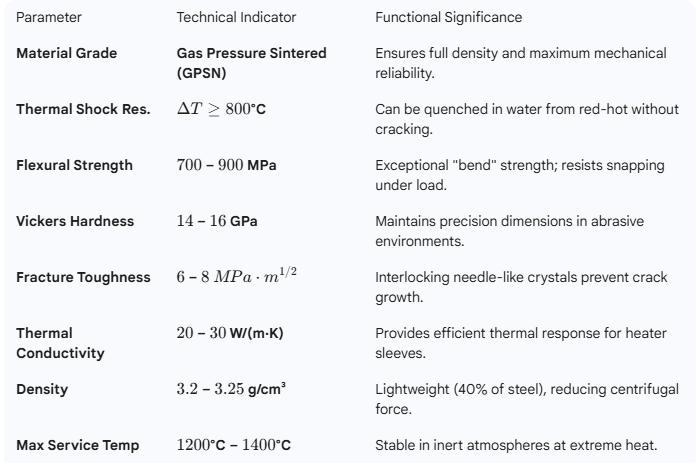
Superior fracture toughness and mechanical strength, Low density (40% of steel), Excellent thermal shock resistance, Outstanding wear resistance and self-lubricating properties, High chemical resistance (acid/alkali), High-temperature stability (up to 1200°C), High modulus of elasticity.
Application Fields:
High-speed motor shaft sleeves, Precision bearings for aerospace, Turbocharger rotors, Molten aluminum handling components, Chemical pump shaft protection, Locating pins for resistance welding, Internal combustion engine valves.
Application Industries:
Biomedical (High-durability implants), Advanced Machinery (High-speed spindles), New Energy (EV motor components), Fluid Control (Abrasive media valves), Electronic Engineering (Semiconductor handling), Aerospace (Jet engine sensors), Petrochemical (Corrosive environment components), Broad Semiconductor (Etching chamber parts).
Processing Difficulties:
Achieving micron-level tolerances on an extremely tough and hard material, Managing the complex sintering shrinkage of GPSN, Maintaining high surface finish ($Ra < 0.1\mu m$) to ensure low friction in high-speed applications, Preventing micro-defects during precision diamond honing.
Processing Flow:
Si_3N_4 powder preparation → Cold Isostatic Pressing (CIP) → Green machining → Gas Pressure Sintering (GPSN) → Diamond internal/external cylindrical grinding → Mirror honing and polishing → Ultrasonic flaw detection → CMM inspection → Secure packaging.
Delivery Period:
Standard specifications: 25-35 days, Customized high-precision or complex sleeves: 45-60 days.

The Silicon Nitride Ceramic Sleeve is the ultimate upgrade for mechanical systems requiring high speed, high temperature, and extreme durability. Unlike traditional ceramics, Si_3N_4 exhibits a unique "needle-like" microstructure that provides exceptional toughness, making it far less prone to catastrophic failure than alumina. Its low density significantly reduces centrifugal force in rotating applications, allowing for higher RPMs and extended service life. With a thermal expansion coefficient much lower than metal, it maintains precise clearances even under extreme thermal cycling, providing a stable and reliable solution for the most demanding aerospace and industrial engineering challenges.
Key Features:
Extreme Mechanical Durability: Combines high hardness with exceptional fracture toughness.
Low Inertia & High Speed: 60% lighter than steel, reducing bearing load and friction at high RPMs.
Inert to Molten Metals: Especially resistant to non-ferrous melts like aluminum, preventing dross buildup.
Thermal Shock Immunity: Can withstand rapid heating and cooling cycles without structural degradation.
Our Market Advantages
What are the main material options available for your ceramic sleeves?
We manufacture our ceramic sleeves using two primary materials: Gas Pressure Sintered Silicon Nitride (GPSN) and Hot-Pressed Silicon Nitride (HPSN). Both provide superior fracture toughness and thermal stability compared to traditional alumina ceramic parts, ensuring enhanced performance in demanding industrial environments.
Can you customize the dimensions and properties of the ceramic sleeves to fit specific equipment?
Yes, we offer customization tailored to your application requirements. Our expertise in alumina ceramic machining and advanced processing techniques enables us to precisely control tolerances, surface finish, and mechanical properties, ensuring optimal integration with your equipment.
How should I handle installation and maintenance of these silicon nitride ceramic sleeves?
We recommend careful handling during installation to maintain the micron-level tolerances and surface finish. Our sleeves are designed for durability and low wear, but routine inspection is advised to monitor performance, especially in high-speed or high-temperature conditions, to maximize service life.
What is your standard delivery time, and do you support international shipping?
Our standard delivery period for high-performance ceramic sleeves is 25-35 days, with 45-60 days for customized orders. We have experience serving global clients and provide reliable logistics support to ensure timely delivery of industrial ceramic solutions worldwide.


